Blogs
When Your Horse Mirrors What You Can't Name
Every trot step felt like someone was stabbing me in the chest.
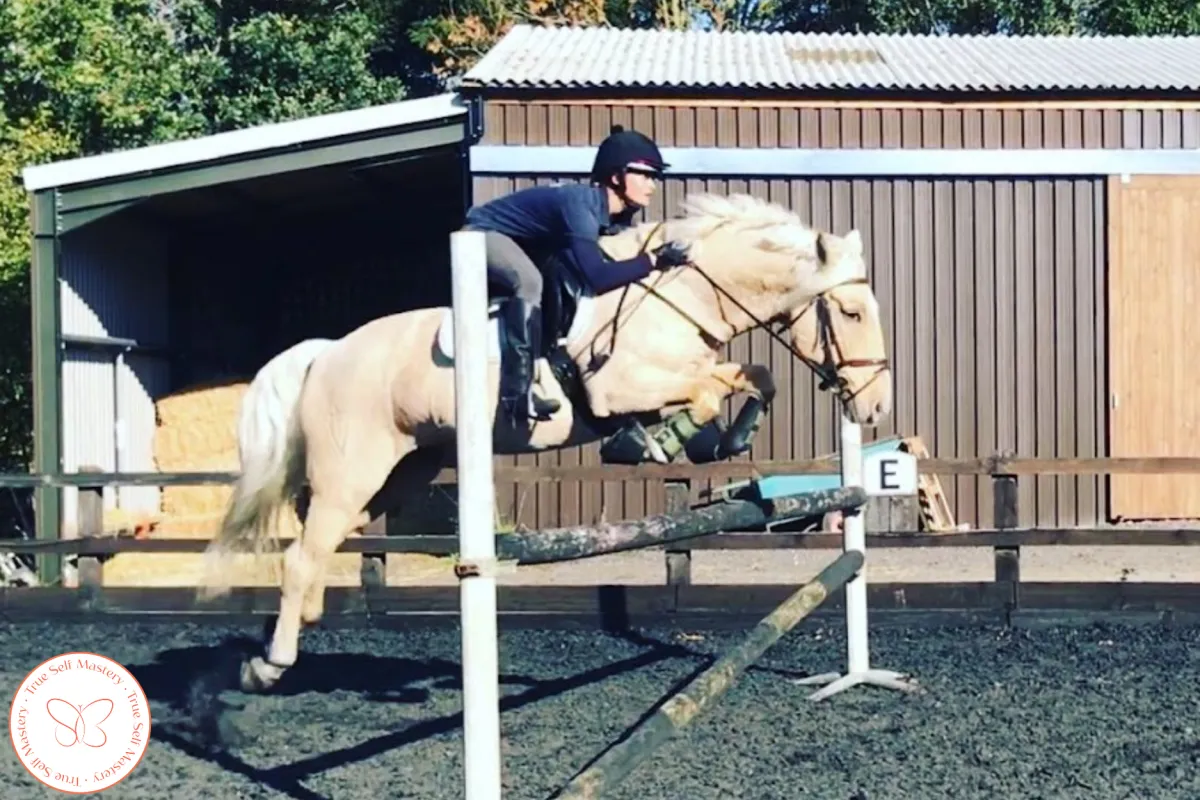
I was thirteen, in a dressage lesson during sitting trot.
My face tightened with each stride, my breathing shortened, and my shoulders crept toward my ears.
My pony felt it immediately and tightened under me, lifting his head, hollowing his back, and resisting every aid I gave.
My instructor watched for a minute, then said: "Relax. You're riding too stiff."
I wanted to cry, not because of his comment, but because I felt misunderstood by everyone—including myself.
The pain was hormonal, but I had no language for that. My body was changing in ways that made sitting trot unbearable. The tension wasn't something I could control, but I didn't know that then.
I just thought there was something wrong with me.
And I thought my pony was being difficult.
My pony wasn't being difficult—he was doing exactly what horses do by mirroring me.
The invisible pain in my body created visible tension he could feel. The soreness I was trying to hide showed up in how I held my breath, gripped with my thighs, braced through my back.
My pony wasn't the problem, and neither was I.
We were both responding to something I didn't have language for.
The Pattern You Can't See Until You Know to Look
At thirteen, I didn't understand this because I had no data, no awareness, no tracking system.
At thirty-seven, I do.
What I've learned after three decades of working with horses is that invisible pain creates visible tension horses mirror immediately. And that pain comes in more forms than most riders realize.
Hormonal pain is what I experienced at thirteen. The soreness, the discomfort, the physical changes that happen during puberty, menstruation, PCOS, perimenopause, or menopause. Pain that fluctuates with your cycle. Pain you might not even consciously register as "pain" until your horse shows you the tension it creates.
Emotional stress is what many of my clients carry into the arena. The difficult conversation they had at work. The email they're dreading. The relationship tension they're trying not to think about. The grief they're processing. The anxiety that sits in their chest. All of it invisible. All of it creating tension their horse feels instantly.
Physical tension from sitting at a desk, carrying stress in your shoulders, compensating for an old injury, or simply being tired. The stiffness you don't notice anymore because you've adapted to it. Your horse hasn't adapted. Your horse mirrors it exactly.
Each type of pain creates the same pattern: invisible to you, visible to your horse.
The rider doesn't name it, so she doesn't address it. She tries to fix the horse instead. And the problems keep coming back.
What Tracking Changed for Me
I track my cycle. I track my energy. I track how my body feels on different days.
And when I look at the patterns now, it's unmistakable.
On certain days of my cycle, my horses feel tighter, more resistant, and less willing to soften.
This isn't coincidence, training regression, or bad luck.
It's my body carrying tension I don't always name, and my horses reflecting it back to me.
Tracking gave me something I didn't have at thirteen: predictability.
I can predict when my body will be carrying more tension. I can predict when my horse is more likely to show restriction or resistance. I can predict when I need to adjust my approach because what I'm asking from my horse needs to account for what my body is bringing to the partnership.
This doesn't mean I stop riding on difficult days. It means I ride differently. I adjust my expectations. I focus on connection rather than pushing through. I give myself—and my horse—permission to work within what my body can actually offer that day.
The tracking itself is simple:
Where am I in my cycle?
How is my energy today (1-10)?
What physical sensations am I aware of?
What emotional state am I carrying?
That's it. Four questions. Most days it takes less than a minute to check in with myself before I walk into the arena.
But that one minute changes everything.
What to Do When You See the Pattern
Once you understand that your horse mirrors what you're carrying, the question becomes: what do you do about it?
Here's the framework I use with every client:
Observe what your horse is showing you
Before you assume your horse "woke up wrong" or "is being difficult," pause and observe. What specifically are they showing you? Tension in the jaw? Resistance to bending? Holding their breath? Bracing through the ribcage? Shutting down?
Don't judge it. Just notice it.
2 . Ask what you might be bringing
This is the hardest step because it requires honesty. What tension are you carrying right now? Where in your body are you tight or uncomfortable? What emotion are you holding? What happened before you got to the barn?
If you can't identify anything specific, that's okay. Simply asking the question creates awareness.
3. Test a different approach
Based on what you noticed, try one small adjustment. If you're holding your breath, focus on breathing fully. If your shoulders are tight, release them consciously. If you're carrying stress, take three slow breaths before mounting.
Then see what your horse does. Do they soften? Do they release tension? Do they engage differently?
4. Adjust based on their response
Your horse will tell you if the adjustment worked. If they soften, you've identified something real. If nothing changes, try a different adjustment. This isn't about getting it perfect—it's about staying in conversation with your horse rather than imposing a fixed plan.
The goal isn't to eliminate all tension from your body. That's not realistic. The goal is to be aware of what you're bringing so you can work with it instead of against it.
Why This Changes Everything
This is why I see so many women spend thousands on trainers, saddle fitters, vets, treatments—and the problems keep coming back.
They're treating the mirror, not the source.
The horse shows restriction, so they adjust the saddle; the horse shows resistance, so they bring in another trainer; the horse shows stiffness, so they book another bodywork session.
The horse improves temporarily, then regresses.
The horse was never the problem—the horse was the messenger.
When you understand that invisible pain creates visible tension your horse mirrors immediately, everything changes.
Instead of cycling through solutions that only address symptoms, you examine what you're bringing into the arena—physically, hormonally, emotionally.
And you learn to track patterns the way I do now. So you can predict when your body is carrying something that will show up in your horse. So you can adjust your approach based on what your body is telling you that day.
Understanding the Partnership
The Horse Listener framework teaches you to observe what your horse is showing you about what YOU'RE carrying, ask what it means, test different approaches, and adjust based on their response.
The work focuses on understanding the partnership.
When you develop this awareness, every interaction with your horse becomes progress. Not confusion. Not frustration. Not another expensive treatment that doesn't address the real issue.
Just clear communication between two bodies that are finally working together instead of against each other.
⤥ Learn about The Horse Listener framework: https://www.nikavorster.com/the-horse-listener
NIKA VORSTER is an equine chiropractor, former GB representative, and creator of The Horse Listener framework. She helps riders understand what their horses have been showing them all along.